Zakeke's Glossary
3D Product Configurator
Focused on customizable made-to-order products, this tool allows customers to personalize attributes like colors, materials, and components. It is suitable for items like shoes, furniture, cars and any other product that can be on-demand manufactured. The output is a list of customizable options for the merchant to produce the custom product. For a practical example, take a look at this demo.
The user interface of the configurator is composed of an iframe that communicates via javascript with the page hosting the iframe. The data exchanged concern:
- Data to initialize the configuration of a product.
- Data regarding prices and availability of the product that you have chosen to initialize.
- Adding the configured product to cart.
Attributes & Options
Attributes define the characteristics you can modify or customize in a product, while options are the specific choices available within each attribute that customers can select or combine to tailor their product according to their preferences.
Attributes and options are fundamental in providing choices within a product. In the shoe-selling scenario:
Attributes are the distinct characteristics or features of a product that can be varied or customized. For instance:
- Attribute 1: Material of the shoes
- Attribute 2: Outside color
Options, on the other hand, are the specific choices available within each attribute. Using the previous example:
- Attribute 1 (Material of the shoes ) has 5 options: red, blue, green, black, and white.
- Attribute 2 (Outside color) also has 5 options: red, blue, green, black, and white.
The options represent the variations or choices within each attribute. Customers can mix and match these options across different attributes, giving them the freedom to create their preferred combination. This flexibility allows for a more personalized shopping experience.
Composition
"Composition" refers to a comprehensive list of attributes and options resulting from a configuration through the 3D configurator.
For example:
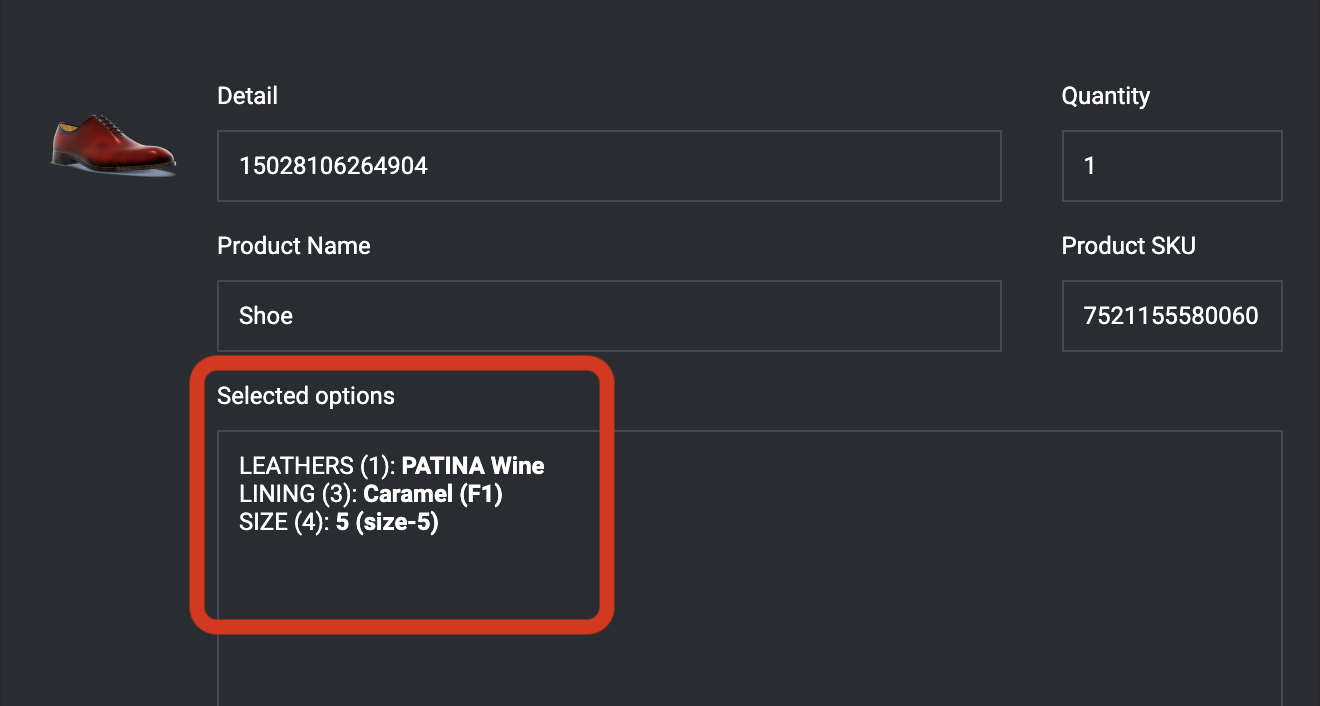
The customer enjoys the liberty of personalizing their shoes, selecting from a range of options including material, color, interior, and size. The customer will choose leather as material, patina wine as the color, the interior color will be caramel and the size of the shoes will be 5. In this instance, the customer's composition will be:
-
Material: Leather
-
Color: Patina Wine
-
Interior: Caramel
-
Size: 5
Designs
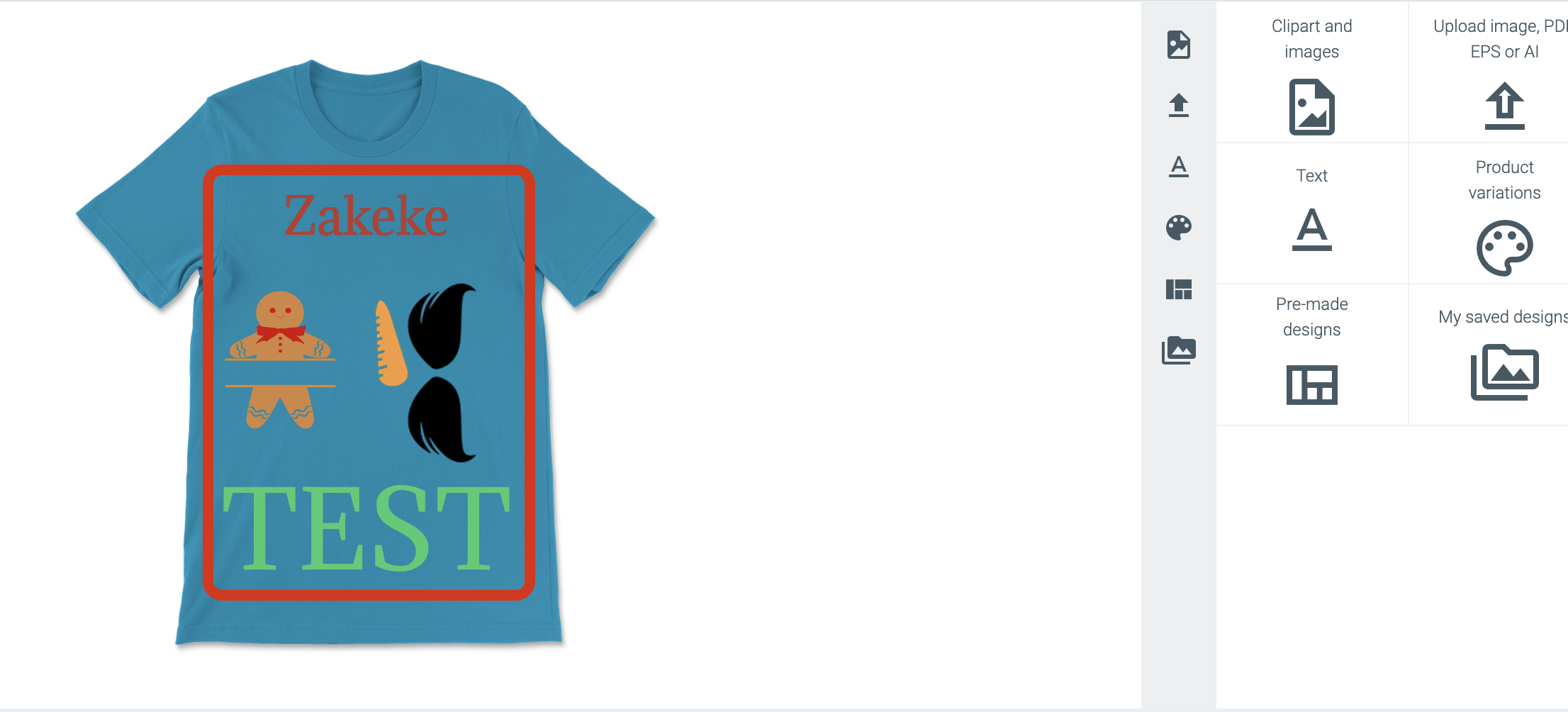
"Designs" refer to the entirety of artwork or graphical elements created by the customer during the personalization process using the Visual Product Customizer.
Orders
When a customer places an order on your e-commerce platform, and it includes a customized item through Zakeke, Zakeke generates an internal order (you find it in the "orders" section in your back-office). It's important to note that the order within Zakeke serves as an additional record and does not replace the original order in your e-commerce system, which remains the primary reference.
The Zakeke order is assigned the same order number as the corresponding order in your e-commerce platform. Rather than replacing the original order, it functions as a supplementary record used to capture all information related to the customization carried out by the client. This includes the retrieval of production-ready files, ensuring a comprehensive overview of the customization details for efficient processing.
Pre-built Connectors
Pre-built connectors are connectors that don't require any coding process, offering integration with e-commerce platforms. These connectors are availbe for the main ecommerce platforms such as Shopify, WooCommerce, PrestaShop and more. For more info click here.
Printing Methods
Printing Methods are a core part of Zakeke. This is where you can create a printing method and assign it to one or more products, sides, or even variants. Printing Method is a profile where you can customize settings for your print-ready files and the customization tools for your product(s). To learn more about printing methods, click here
Print-Ready Files
For orders processed through the Visual Product Customizer, Zakeke provides you with print-ready files, meaning files that already meet all the requirements for high-quality printing, according to the settings you have configured in the back office. You don't need to do anything to prepare your files for printing.
Zakeke generates print-ready files in several formats. For further information, please refer to our dedicated guide here.
Products' Catalog
Products' Catalog is a list of products imported from online store platforms (Wix, Etsy…) and then configured in Zakeke . In the case of API, these products are imported either through product sync or via CSV files.
Reference Key (EntityReferenceKey)
A reference key (technically the EntityReferenceKey) is a stable identifier that you choose to address a Zakeke entity from the outside — your own SKU, code or ID. It is the canonical identifier that ties a Zakeke entity to its counterpart in your systems, and it is what external integrations, the CSV v3 bulk import and several UI features use to refer to that entity in a way that stays valid over time (unlike Zakeke's internal numeric IDs).
Many kinds of entity can carry a reference key, including:
- Products, variants, sides and print areas
- Printing methods
- Image categories and image macro-categories
- Pre-designed template categories and macro-categories
Uniqueness / scope. How unique a reference key must be depends on the entity:
- Product and Printing-method keys are unique across your whole account.
- Variant and Side keys are unique only within their parent product — two different products can both have a
redvariant or afrontside. - A simple product (one that has no real variants) must declare a single variant with the reserved key
DEFAULT_VARIANT.
Because the reference key is stable, Zakeke uses it to upsert: an operation that carries a new key creates the entity, while one that carries an existing key updates it. Re-sending the same data therefore produces no further change (it is idempotent). See Operation semantics in the CSV v3 guide.
Where to configure it
You can assign a reference key in two ways:
1. Back-office (UI).
-
On an individual entity, through the Edit reference key action available in the relevant section.
-
In bulk, through the Prepare your catalog / Setup screen of the bulk-import tool, which lists every catalog item that does not have a reference key yet (grouped by entity type) and lets you assign them inline, with search, per-product filter and an auto-suggest helper.
2. CSV v3 bulk import.
- Every canonical file exposes an
EntityReferenceKeycolumn for the entity it describes, and child files point to their parent through the matching…ReferenceKeycolumns (e.g.ProductReferenceKey,VariantReferenceKey,SideReferenceKey). See the CSV v3 method guide for the full details.
Only the items you want to include in bulk operations, external integrations or reference-key–based UI features need a reference key. Existing catalog items without one keep working in the back-office exactly as before — they are simply invisible to those flows until a key is assigned.
Side(s)
A customizable product can have multiple views such as front and back for a T-shirt. In Zakeke product views are called sides.
You can set as many sides as you want for a customizable product and as many print areas as you want on each side.
You set sides when you first create your customizable product, but you can add/remove sides or edit exiting sides at any time in the product configuration wizard by clicking on the name of the product that you wish to edit from Customizable Product. To see the full documentation about sides click here
Visual Product Customizer
Visual Product Customizer is the tool you should use if your product is customizable with added artwork. This means you want to empower your customers to incorporate their own unique elements, such as texts, images, or distinct designs. Whether it's editing pre-designed artwork onto a product, this tool is the perfect fit.
Zakeke API Keys
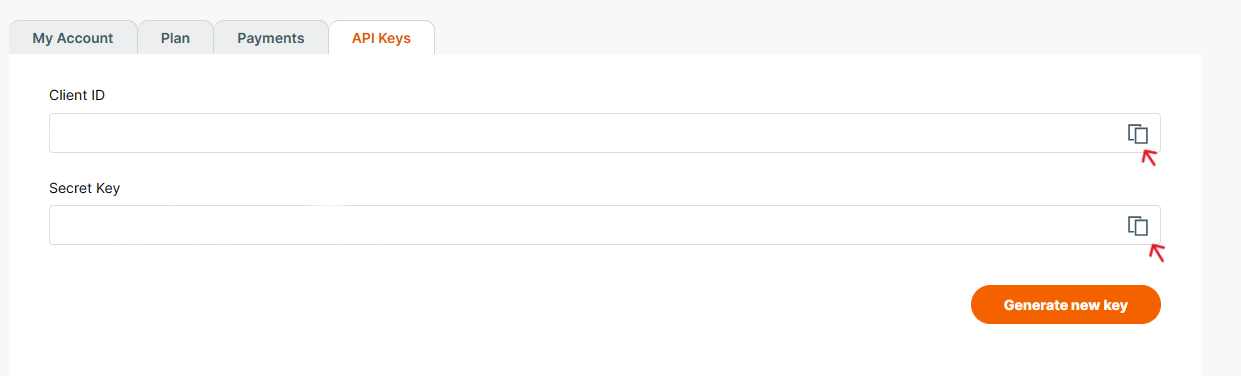
You can obtain your Zakeke client ID and secret key by going to your account and then click on API keys.